
Hazard Dice Game
Hazard Dice Game
Rules that govern the Hazard game. Basically, two dice are used in playing the game. Multiple players, who play side by side, bet among themselves on the odds of “caster’s” or “fader’s” point being cast first. Any player is at liberty to begin the game either by casting or shooting. The game of Craps likely developed over time and involves a little bit of all these widely believed theories. Some theories suggest the game is based on the Old English game called Hazard and a French game called Crabes.
| Players | 2+ |
|---|---|
| Setup time | < 1 minute |
| Random chance | High, Dice rolling |
| Skill(s) required | Luck, Hands, Betting, Ability to Cheat |

Hazard: one of the best-known period dice games, generally regarded as the forerunner of modern Craps. Dagonell's description. A brief description on the Landsknecht page. A brief description from the Tattershall Trayned Band. Hnefatafl: See Tafl. Imperator: See Tables Games. Hazard dice game. The hazard from the game can be compared to a particular biological hazard recognized in a food product. Here’s a hint: craps in a very simplified version of it.
Hazard is an early English game played with two dice; it was mentioned in Geoffrey Chaucer's Canterbury Tales in the 14th century.
Despite its complicated rules, hazard was very popular in the 17th and 18th centuries and was often played for money. At Crockford's Club in London, hazard was especially popular. In the 19th century, the game craps developed from hazard through a simplification of the rules. Craps is now popular in North America but neither game remains popular amongst the rest of the world.
Rules[edit]
Any number may play, but only one player – the caster – has the dice at any one time.
In each round, the caster specifies a number between 5 and 9 inclusive: this is the main. He then throws two dice.
- If he rolls the main, he wins (throws in or nicks).
- If he rolls a 2 or a 3, he loses (throws out or outs).
- If he rolls an 11 or 12, the result depends on the main:
- with a main of 5 or 9, he throws out with both an 11 and a 12;
- with a main of 6 or 8, he throws out with an 11 but nicks with a 12;
- with a main of 7, he nicks with an 11 but throws out with a 12.
- If he neither nicks nor throws out, the number thrown is called the chance.[1] He throws the dice again:
- if he rolls the chance, he wins;
- if he rolls the main, he loses (unlike on the first throw);
- if he rolls neither, he keeps throwing until he rolls one or the other, winning with the chance and losing with the main.
This may be simpler to follow in a table:
| Main | Nicks | Outs | Chance |
|---|---|---|---|
| 5 | 5 | 2,3,11,12 | 4,6,7,8,9,10 |
| 6 | 6,12 | 2,3,11 | 4,5,7,8,9,10 |
| 7 | 7,11 | 2,3,12 | 4,5,6,8,9,10 |
| 8 | 8,12 | 2,3,11 | 4,5,6,7,9,10 |
| 9 | 9 | 2,3,11,12 | 4,5,6,7,8,10 |
The caster keeps his role until he loses three times in succession.[2] After the third loss, he must pass the dice to the player to his left, who becomes the new caster.
Betting[edit]
Bets are between the caster and the bank (the setter), which may be the remaining players acting as a group.
If the caster nicks on the first throw, he wins an amount equal to his stake. After the first throw, the caster wins his stake if he gets his chance before his main.
After the first throw, the caster (and others, via side bets) may wager an additional sum that the chance will come before the main. These bets are made at odds determined by the relative proportions of the main and the chance:
| Main | Chance | ||||||
|---|---|---|---|---|---|---|---|
| 4 | 5 | 6 | 7 | 8 | 9 | 10 | |
| 5 | 4/3 | — | 4/5 | 2/3 | 4/5 | 1/1 | 4/3 |
| 6 | 5/3 | 5/4 | — | 5/6 | 1/1 | 5/4 | 5/3 |
| 7 | 2/1 | 3/2 | 6/5 | — | 6/5 | 3/2 | 2/1 |
| 8 | 5/3 | 5/4 | 1/1 | 5/6 | — | 5/4 | 5/3 |
| 9 | 4/3 | 1/1 | 4/5 | 2/3 | 4/5 | — | 4/3 |
For example, with an odds stake of £10, a main of 7 and a chance of 5, a caster stands to win £15 (3/2 × £10); with the same stake, a main of 5 and a chance of 6, he could win £8 (4/5 × £10).
Probability of winning[edit]
For each main the probability of winning can be calculated:
More Hazard Dice Game Images
| Main | Probability of winning | Disadvantage to caster |
|---|---|---|
| 5 | 0.492 | 1.52% |
| 6 | 0.488 | 2.34% |
| 7 | 0.493 | 1.41% |
| 8 | 0.488 | 2.34% |
| 9 | 0.492 | 1.52% |
In some reports[3] on the rules of the game, the main is determined randomly by tossing the dice until a valid main appears. In this case the overall player disadvantage is 1.84%. If the caster can choose a main, he should always choose 7 (resulting in the lowest disadvantage, with 1.41%). This is the origin of a similar dice game, craps, since if 7 is always chosen the game devolves into craps.
Etymology of the name[edit]
The name 'hazard' is borrowed from Old French. The origin of the French word is unclear,[4] but probably derives from Spanishazar ('an unfortunate card or dice roll'), with the final -d by analogy with the common French suffix -ard.[4][5] The Spanish word has been supposed in turn to come from Arabic, either from the name of a castle in Palestine,[4] or from the word az-zahr (الزهر) meaning 'dice'.[4][5] However, early evidence for this word in Arabic is lacking, as it is absent from Classical Arabic dictionaries, making the etymology doubtful (although any other source is unknown).[4][5] Another possibility is Arabic yasara ('he played at dice').[5]
Derivations from Hazard[edit]
From the game of Hazard came the modern terms:
- Possibly, the phrase 'at sixes and sevens' (another possible derivation is discussed under that article). 'Set upon six and seven' first appeared in Chaucer's Tales relating to betting one's entire fortune on a single throw of the dice. Over time the phrase became associated with any circumstances involving general confusion or disorder.
- The word 'hazard' in its modern sense of 'risk' or 'danger'.
References[edit]
- ^Chisholm, Hugh, ed. (1911). 'Hazard' . Encyclopædia Britannica. 13 (11th ed.). Cambridge University Press. p. 117.
- ^Steinmetz, John. [1]Archived 2000-01-26 at the Wayback Machine 'The Gaming Table'.
- ^Scarne on Dice, John Scarne (1980)
- ^ abcde'Hazard'. Oxford English Dictionary. Retrieved 11 August 2009.
- ^ abcd'Hazard'. Online Etymological Dictionary. Retrieved 11 August 2009.
Hazard Dice Game
Further reading[edit]
| Look up hazard in Wiktionary, the free dictionary. |
- Steinmetz, Andrew (1870). The Gaming Table, Volume II, Chapter X. (Online edition available at World Wide School.)
by Dagonell the Juggler
Games That Use 5 Dice
Sir William of Tyre claimed that he and his fellow knights inventedthe game of Hazard during the crusades under Charlemagne. They did it to passthe time while laying siege to the castle of Hazarth in 1125. This would imply that the game is named after the castle. The Encyclopedia Britannica however, states that game takes its name from the Arabic words 'al zar', which means simply, 'the dice'. Geoffrey Chaucer makes frequent mention of the game in his Canterbury Tales as an analogy for life, with runs of both good and bad luck.
Hoyle's Book of Games says that Hazard is simply another name for thegame Craps. This is incorrect. Craps is a simplification of Hazard thatwas created by the French in the late sixteenth century. The name comes fromthe English slang term for a roll of two or three, 'craps' which comes from theFrench slang term 'krabs'.
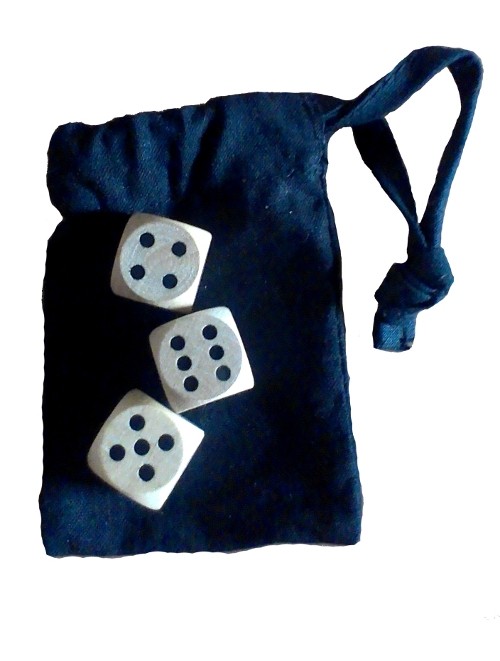
The Hazard game in the Dungeon and Dragon manuals is actually acasino game called Grand Hazard. Modern gambling casinos invented the game toseparate tourists from their money. Serious gamblers won't play it becausethe payoff odds are ludicrous.
TO PLAY CRAPS: The dice roller, who is called the 'shooter' acceptsbets from the players betting against him, who are called the 'faders'. Ifthe first roll is 7 or 11, this is a 'natural' and the shooter wins immediatelyand may play again. If the first roll is 2, 3, ('craps') or 12, ('boxcars') the shooter loses his bet but retains control of the dice and may play again.Any other roll is the shooter's 'point'. Different point totals have different odds and the faders may make additional bets with the shooter or among themselves.
The shooter now tries to re-roll his point without rolling a sevenfirst. If he rolls a seven, he loses both his bet and control of the dice.If he rolls or 'makes' his point, he wins his bet and may play again.
TO PLAY HAZARD: The shooter first tries to roll a 'main point' or'faders point', a total between 5 and 9 inclusively. Any other point totalis re-rolled. After a main point has been established, the shooter thentries to roll a 'chance point' or 'shooters point', a total between 4 and 10inclusively, which is not the main point.
However, it is possible for the shooter to win or lose before establishing a chance point. If he rolls the main point again, he wins. If herolls a 2 or 3, he loses his bet but retains control of the dice and may play again. If he rolls a 12 and the main point is even (6 , 8) he wins. If he rolls a 12 and the main point is odd (5, 7, 9) he loses. If he rolls an 11 and the main point is 7, he wins. If he rolls an 11 and the main point isn't 7, heloses. If that sounds rather complex, you're not alone. My wife refers tothis game as 'Medieval Fizzbin'. ;-) The table may be simpler:
See Full List On Wizardofodds.com
Once the chance point has been established, no other roll mattersexcept the main point and the chance point. The shooter continues rolling until he rolls the chance point and wins, or the main point and loses.
Hazard Dice Game